


What Is PPF on a Car?
If you’ve ever wondered how people keep a daily-driven car looking “brand new” for years, the answer is often PPF – short for Paint Protection Film.
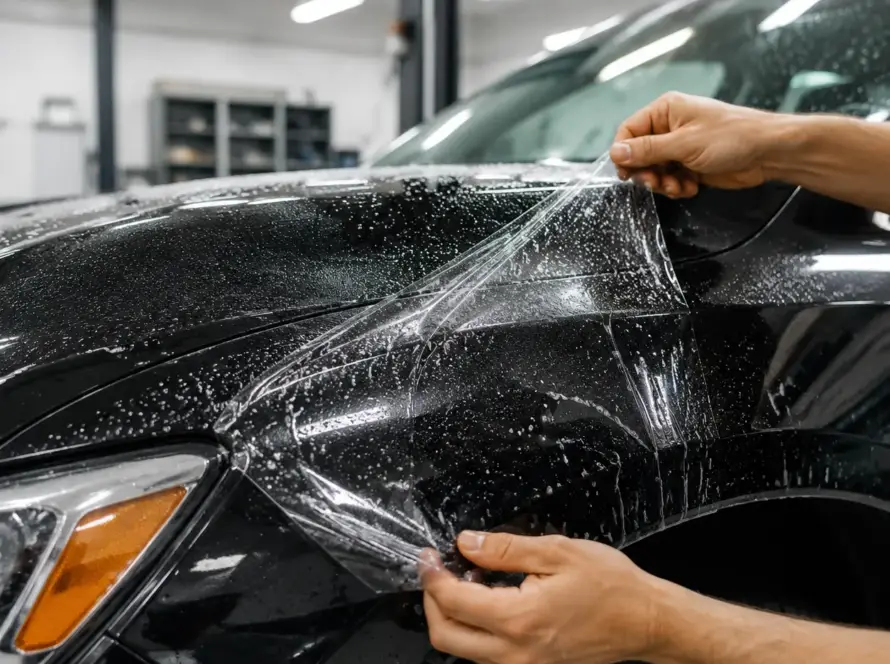
Paint protection film (PPF) is a clear, urethane-based film that’s applied directly on top of your car’s paint. Think of it as invisible armor: a transparent, flexible layer that takes the abuse from the road so your factory paint doesn’t have to.
Simple Definition: PPF in Plain English
- PPF = clear bra / clear film that sits on the paint
- It’s see-through, so your original color and finish still show
- It acts as a sacrificial layer: if something hits your car, it hits the film first, not the paint
When rocks, sand, salt, or other road debris kick up at highway speed, PPF absorbs the impact, helping prevent rock chips, scratches, and road rash on your front end and other exposed areas.
Where PPF Is Usually Installed
You don’t have to wrap the whole car (though you can). Most owners choose coverage based on where their car takes the most abuse:
- Front end (most common)
- Front bumper
- Full or partial hood
- Front fenders
- Side mirrors
- High-impact zones
- Rocker panels (below doors)
- Door edges and door cups (behind handles)
- Rear bumper top (loading area)
- Full-body PPF
- For maximum protection on high-end, collectible, or long-term keeper cars
We design our coverage patterns to hit these high-impact areas first, then build up from there depending on your budget and how you drive.
Who Actually Needs PPF?
PPF isn’t just for show cars and exotics. It makes real-world sense for:
- Daily drivers
- You park in tight lots, drive in traffic, and deal with door dings and shopping carts.
- Highway commuters
- Lots of miles = lots of rock chips. Front-end PPF is almost mandatory here.
- Luxury and performance cars
- Expensive paint and bodywork mean one repaint can cost more than a PPF package.
- New car buyers and lessees
- You want to keep that factory paint as clean as possible for years and protect resale or lease return value.
If you care about how your car looks long term—or you simply hate seeing fresh chips on your hood—PPF on a car is one of the most effective forms of paint protection you can buy.
How Paint Protection Film Works
Basic Structure of Car Paint Protection Film (PPF)
In plain terms, paint protection film is a clear, layered plastic shield that sits on top of your paint. Most modern PPF (like XPEL, 3M, LLumar, and our own premium films) is built like this:
| Layer | What It Does |
|---|---|
| Top Coat | Gloss or matte finish, self-healing, stain resistance, UV filter |
| TPU Core | Thick impact layer (thermoplastic polyurethane) that takes the hit |
| Adhesive | Clear, pressure-sensitive glue that bonds to the paint safely |
That TPU middle layer is what really gives you rock chip protection and road rash defense on your front end, rocker panels, and other high-impact areas.
How PPF Absorbs Rock Chips and Road Debris
When you hear “rock chip protection film,” this is what’s happening:
- A rock or piece of debris hits the car.
- The TPU layer flexes, absorbs the impact, and spreads it across a wider area.
- Instead of cutting into your paint, the energy is dispersed inside the film.
- Worst case, you replace a piece of film – you don’t repaint the panel.
This is why highway drivers and folks in states with gravel, road construction, or winter sanding (think Colorado, Utah, Midwest, Northeast) see a huge payoff from PPF front end protection.
Self-Healing Paint Protection Film Explained Simply
Self-healing paint protection film sounds fancy, but it’s pretty simple:
- The top coat is made from a memory polymer.
- Fine swirls and light scratches don’t cut deep, they just distort the surface.
- When the film gets warm (sunlight, warm water, or a heat gun used correctly), the polymer relaxes and returns to its original smooth shape.
- Those light marks visually disappear without polishing.
There are two common types:
| Type | What It Does |
|---|---|
| Standard self-healing | Heals with warm water or heat; a bit slower |
| Instant-healing PPF | Heals at room temp or light heat; faster and more convenient |
This is one of the biggest reasons self-healing clear bra for cars is more popular than older-style films.
UV, Fading, Oxidation, and Stain Protection
Modern UV-resistant paint protection film doesn’t just stop rock chips; it also defends your factory paint protection from the elements:
- UV Blockers – The film filters UV so your paint doesn’t fade or oxidize as quickly.
- Chemical Resistance – It helps protect against:
- Bird droppings
- Bug guts
- Tree sap
- Road salt and de-icer
- Stain Resistance – Premium hydrophobic PPF makes it harder for grime to bond, so the car:
- Washes easier
- Stays cleaner longer
- Gets less etched and stained over time
This is a big plus for cars in hot southern states, coastal regions, and snowbelt areas where sun and salt beat up paint fast.
Cheap PPF vs Premium Automotive Protection Film
Not all car paint protection film is created equal. The differences are huge:
| Feature | Cheap Low-Quality Film | Modern Premium PPF (Anti-Yellowing) |
|---|---|---|
| Clarity | Hazy, orange peel, distorts reflections | Very clear, OEM-like gloss or even better |
| Yellowing | Yellows fast in sun and heat | Built-in anti-yellowing tech, tested for US UV |
| Self-Healing | Little to none | True self-healing / instant-healing top coats |
| Durability | Thin, tears or pits easily | Thick TPU, higher impact resistance |
| Adhesive | Can fail, leave glue, or damage paint | Safe, removable adhesive when installed correctly |
| Warranty | Weak or none | 8–12+ years from top brands and our premium line |
If a PPF cost quote is way below market for 2026, it’s usually because:
- The film is cheap, outdated, or off-brand.
- The installer is cutting corners on prep and install.
- The warranty is weak, or the shop may not be around to honor it.
For U.S. drivers who care about resale value, factory paint, and long-term looks, it makes more sense to run premium automotive protection film once than to fight yellowing, peeling, and failed clear bra later.
PPF vs Other Paint Protection Options
When people ask “what is PPF on a car”, they usually also want to know how it stacks up against ceramic coating, wax, and vinyl wrap. Here’s how I explain it to customers in the U.S. every day.
PPF vs Ceramic Coating
Paint Protection Film (PPF) = physical armor.
Ceramic Coating = chemical shield and gloss booster.
Key differences:
| Feature | PPF (Paint Protection Film) | Ceramic Coating |
|---|---|---|
| Main job | Block rock chips, road rash, scratches | Add gloss, ease of cleaning, chemical resistance |
| Type of protection | Physical barrier (thick film) | Chemical barrier (liquid nano coating) |
| Thickness | ~6–10 mil | Microns (very thin) |
| Rock chip protection | Excellent | Almost none |
| Swirl/scratch resistance | Very good (self-healing on good films) | Light resistance only |
| UV / fading protection | Very good | Good |
| Look | Clear gloss or matte finish | Deep gloss, “wet” look |
| Cost (front end, 2026 ballpark) | Higher ($1,000–$2,000+ depending on car) | Lower ($600–$1,500 for whole car) |
Bottom line:
If you’re dealing with highway driving, gravel, or city parking, PPF does the heavy lifting. Ceramic coating can’t stop rock chips.
PPF vs Wax and Sealants
Wax / sealants are basically short-term shine with light protection. Great if you’re on a tight budget, but they don’t compare to PPF.
| Feature | PPF | Wax / Sealant |
|---|---|---|
| Durability | 5–10+ years (quality film) | Weeks to a few months |
| Impact protection | Real chip + scratch resistance | Almost none |
| Maintenance | Easy washing, less need to polish | Needs regular reapplication |
| Weather resistance | Excellent (salt, sand, debris) | Wears down with rain, washing, heat |
| Best for | Long-term protection and resale value | Budget shine and basic protection |
Bottom line:
Wax and sealants are fine if you just want cheap shine. If you care about protecting factory paint on a new or expensive vehicle, PPF is in a different league.
PPF vs Vinyl Wrap
I see a lot of people confuse vinyl wrap and paint protection film. They’re not the same thing.
| Feature | PPF (Clear Bra) | Vinyl Wrap |
|---|---|---|
| Purpose | Protection first, looks second | Style, color change, branding |
| Thickness | Thicker, impact-absorbing | Thinner, not designed for rock chip impact |
| Finish options | Clear gloss, matte, satin, some colored PPF | Any color, printed graphics, textures |
| Protection level | High against chips and road rash | Light – mostly against minor scuffs |
| Typical use | Front end, high-impact zones, full body | Full color change or branding wraps |
Bottom line:
If your goal is style, go vinyl.
If your goal is protecting your OEM paint, go PPF. Some owners do both: PPF on high-impact areas + vinyl elsewhere.
PPF + Ceramic Coating Combo
On most new cars, EVs, and luxury models, the best setup I recommend is:
- PPF on:
- Front bumper
- Hood
- Fenders
- Mirrors
- Rocker panels / rear impact zones (if you drive a lot)
- Ceramic coating:
- On top of the PPF
- On the exposed painted areas (roof, trunk, doors, etc.)
This combo gives you:
- Impact protection from PPF
- Gloss + easy cleaning from ceramic
- Less staining from bugs, bird droppings, and road grime
- A car that’s much faster to wash and dry
PPF handles the abuse. Ceramic makes it easier to live with.
Which Option Fits You and Your Budget?
Here’s how I usually break it down for U.S. customers:
| Owner Type / Use Case | Best Fit |
|---|---|
| New daily driver, highway miles | PPF full front + optional ceramic coating |
| Luxury / sports car, EV, expensive paint | PPF full front or full body + ceramic |
| Short-term lease, city only, low mileage | PPF front bumper only or ceramic only |
| Older car, budget-focused | Ceramic or wax for basic shine |
| Track toy / gravel roads / harsh winters | PPF high-impact package (front, rockers, rear) |
Simple rule:
- If a rock chip or repaint would seriously bother you or crush your resale value, invest in PPF.
- If you just want the car to be shinier and easier to wash, a ceramic coating alone can be enough.
That’s the honest breakdown of what PPF on a car does vs ceramic, wax, and vinyl, and how I’d match each option to different owners and budgets in the U.S. market.
Real Benefits of PPF on a Car

When people ask “what is PPF on a car and is it worth it?”, this is what they really care about: what it does for them in daily driving here in the U.S.
1. Real-World Protection From Damage
Paint protection film for cars acts like a clear armor layer on your most exposed panels.
What it protects against:
- Rock chips & road rash from highway driving and construction zones
- Light scratches & scuffs from car washes, kids, pets, and parking lots
- Door dings & shopping cart taps (minimizes paint damage, doesn’t stop metal dents)
- Sand, gravel, and debris on backroads or winter roads
| Driving Style / Situation | How PPF Helps (PPF front end protection) |
|---|---|
| Daily commute on highways | Cuts rock chip and sandblast damage on bumper & hood |
| City / mall parking | Reduces paint transfer from light door hits |
| Road trips & mountain drives | Shields from gravel, bugs, and road debris |
2. Defense Against Harsh Contaminants
PPF is a barrier between your factory paint and all the nasty stuff that normally etches into clear coat.
Protected against:
- Bird droppings
- Bug guts (especially on highway runs)
- Tree sap & pollen
- Road salt & de-icer (big deal in northern states and coastal areas)
These things normally stain, etch, or dull your paint. With self healing paint protection film, most of that sits on the film, not your paint, and is much easier to clean off.
3. Keeps Factory Paint Fresher and Glossier
Quality gloss paint protection film gives your car:
- Deeper gloss and shine on dark colors
- Protection from UV fading and oxidation
- A better look for 5–10 years vs unprotected paint
The paint under the film basically “pauses in time,” which matters a lot for new cars, EVs, luxury models, and specialty colors.
4. Boosts Resale Value and Buyer Confidence
In the U.S. used car market, original paint in great shape = more money and faster sale.
How PPF helps you at resale:
- Keeps factory paint intact (no blend lines from repaints)
- Makes the car look newer than its model year
- Signals to buyers that you cared for the car properly
- Helps avoid repaint costs before sale or lease return
For a lot of owners, PPF vs repaint cost is an easy win – a good front-end PPF job often costs less than fixing multiple rock chipped panels down the road.
5. Easier and Faster Washing
With a good hydrophobic paint protection film:
- Dirt, bugs, and road film come off faster
- You can wash with less scrubbing (safer for the finish)
- The car looks cleaner between washes
Pairing PPF with a ceramic coating on top of PPF makes maintenance even easier, especially if you wash at home with a basic two-bucket setup or touchless wash.
6. Peace of Mind for New, Leased, or High-End Vehicles
PPF makes the most sense when damage is expensive or stressful:
- Brand-new cars & leased vehicles – protects you from chargebacks and repaint battles at lease return
- Luxury and performance cars – paint and bodywork costs are higher, so protection pays off quicker
- High-mileage commuters & road-trippers – constant highway use destroys unprotected front ends
You’re basically paying once to stop stressing every time a truck kicks up rocks or you hear gravel hitting the bumper.
Bottom line:
If you drive in real-world U.S. conditions—highways, city streets, winter roads—PPF car protection gives you tangible benefits: less damage, better-looking paint, higher resale, and less stress every time you hit the road.
Types of PPF Films Available
When people ask “what is PPF on a car”, they usually don’t realize how many film options there actually are. Not all paint protection film for cars is the same, and the look and performance can change a lot depending on the type you choose.
Gloss PPF for Extra Shine and Depth
If you like that deep, wet, glossy look, gloss paint protection film is the go-to.
- Adds extra depth and clarity to factory paint
- Makes solid colors and metallics pop, especially black, red, and blues
- Pairs well with ceramic coating vs PPF setups for maximum gloss + protection
- Ideal for ppf on new car, luxury models, EVs, and daily drivers you want looking “better than new”
Good premium automotive protection film in gloss is also very clear, so it doesn’t distort the color of your paint or make it look cloudy.
Matte and Satin PPF for a Stealth Look
Matte paint protection film and satin PPF are for people who want that “stealth” or “frozen” look without repainting.
- Turns a gloss car into a matte/satin finish without permanent paint work
- Protects delicate matte factory paint, which is expensive to repair or repaint
- Hides light swirls better than high-gloss finishes
- Great for performance cars, SUVs, and EVs where owners want something different but still clean and OEM+
You still get all the benefits of rock chip protection film, just with a different finish.
Colored and Fashion PPF Films
This is where style meets ppf car protection.
- Colored PPF: Subtle tints, smoked look for trim, or full-color options
- Fashion PPF: Textured, color-flip, or special-effect films for a custom look
- Lets you change style without committing to a respray
- Still gives you real car clear film benefits—rock chip defense, UV resistance, and easier cleaning
Think of it as a safer, more protective alternative to some vinyl wrap vs PPF options when you still want real impact protection.
Instant-Healing vs Standard Self-Healing PPF
Modern self-healing paint protection film is a big reason people search for “what is paint protection film” at all.
- Instant-healing PPF
- Swirl marks and light scratches fade almost immediately with ambient heat or light friction
- Great for black cars and dark colors that show everything
- Standard self-healing PPF
- Requires warm water, sun, or mild heat to “heal” light swirls
- Still very effective, just not as fast as instant-heal tech
Both use a flexible, elastic top coat that “rebounds” when lightly damaged. This keeps your factory paint protection looking fresh way longer than wax or sealants.
Entry-Level vs Mid-Range vs Premium PPF Films
Not all clear bra for cars is equal. The film you pick has a big impact on how the car looks, how long it lasts, and how easy it is to live with.
Entry-Level PPF:
- Thinner, more basic TPU and top coat
- Less clarity, may look slightly hazy on darker cars
- Shorter lifespan, more likely to show yellowing over time
- Lower price, but usually weaker anti yellowing PPF performance and shorter warranty
Mid-Range PPF:
- Better optical clarity and gloss or matte uniformity
- Decent self-healing and UV resistant paint protection film properties
- Good balance for budget-conscious daily drivers and work vehicles
- Solid warranties but not always the longest
Premium PPF:
- Top-tier clarity and finish (you almost can’t tell it’s there)
- Strong self-healing, often instant-healing
- Advanced hydrophobic paint protection film top coats for easier washing
- Strong resistance to staining, etching, and yellowing
- Longer warranties, better ppf lifespan and warranty confidence
This is the level where you usually see big names like XPEL PPF film, 3M paint protection film, Llumar paint protection film, and the type of film I source for high-end full body PPF coverage and serious ppf front end protection.
If you’re driving a newer car, logging real highway miles, or you care about ppf for resale value, mid-range to premium is where it makes the most sense to be.
PPF Coverage Options on a Car
When people ask “what is PPF on a car,” they really want to know where it should go and how much they actually need. Here’s how I break down paint protection film coverage for most U.S. drivers.
Partial Front PPF Package
Best for: Budget-conscious owners, older cars, light city driving.
Typically covers:
- Front bumper
- Front section of hood (12–24″)
- Front portion of front fenders
- Mirror caps
Pros:
- Lowest cost clear bra option
- Protects the most chip-prone zones
- Good starter package for daily drivers
Cons:
- Visible line across hood/fenders
- Less protection for full hood and fenders
Full Front PPF Package
Best for: New cars, highway commuters, EVs, SUVs, and trucks.
Typically covers:
- Full front bumper
- Full hood
- Full front fenders
- Mirror caps
- Headlights & fog lights
Pros:
- No film line across panels
- Strong rock chip protection for the whole front end
- Ideal balance of cost and protection
Cons:
- More expensive than partial front
High-Impact / Track-Focused PPF Packages
Best for: Performance cars, track cars, off-road use, high-mileage highway driving.
Typically adds PPF on:
- Rocker panels / side skirts
- Lower doors
- Rear bumper impact areas (behind wheels, trunk ledge)
- A-pillars and front of roof
- Rear fender flares / quarters
Pros:
- Targets areas that get blasted by road debris and rubber
- Great for wide-body, low, or aggressive wheel setups
Cons:
- Cost increases with each added panel
Full-Body PPF Coverage
Best for: High-end vehicles, luxury / exotic cars, show cars, long-term owners.
Covers:
- Every painted panel on the car
- Sometimes gloss or matte PPF to change the finish
Pros:
- Maximum rock chip and scratch protection
- Makes the whole car easier to maintain
- Best for preserving factory paint and resale value
Cons:
- Highest upfront cost
- Requires a very skilled installer
How to Choose PPF Coverage Based on How You Drive
Use this quick guide to match PPF car protection to your situation:
| Driving Style / Situation | Recommended PPF Coverage |
|---|---|
| City driving, low mileage | Partial Front |
| Daily commute, mixed city + highway | Full Front |
| Heavy highway use, long road trips | Full Front + Rocker Panels / Lower Doors |
| Track days, spirited canyon / backroad runs | Full Front + High-Impact Package |
| Luxury, exotic, or long-term ownership | Full-Body PPF Coverage |
| Harsh climates (salt, gravel, desert, bugs) | Full Front at minimum, consider High-Impact |
If you’re in the U.S. and rack up highway miles or just bought a new car you plan to keep, full front PPF is the sweet spot. If the car is a high-value or “forever” car, full-body paint protection film is the move.
PPF Installation Process Explained
Why Proper Surface Prep Matters
With paint protection film (PPF), the install is only as good as the prep. If the surface isn’t perfectly clean and smooth, you’ll see it through the film.
Here’s what a solid prep process looks like:
- Thorough wash:
- pH-neutral car shampoo
- Foam pre-soak to loosen dirt
- Two-bucket wash to avoid new swirls
- Decontamination:
- Chemical decon for iron and tar spots
- Clay bar or clay mitt to pull out embedded grit
- Polish if needed:
- Light machine polish to remove minor swirls and water spots
- Deep defects are corrected before film, otherwise they get locked in
- Panel wipe:
- Isopropyl alcohol (IPA) or dedicated panel prep to strip oils and wax
- Ensures the adhesive on the PPF bonds properly
On a brand-new car in the U.S., I still treat prep seriously. Dealer “detail” work often leaves swirls, fillers, and silicone that must be removed before any clear bra goes on.
How PPF Is Cut: Pre-Cut Patterns vs Custom Bulk
Shops in the U.S. use two main methods: pre-cut kits and bulk/custom installs. I run both, depending on the job.
Pre-cut pattern PPF (plotter-cut):
- Uses software and a plotter to cut PPF to your exact year/make/model
- Cleaner, more consistent edges
- Less risk of cutting on the car
- Great for high-volume installs and common models (Tesla, Ford, Toyota, BMW, etc.)
Custom bulk install:
- Film is laid on the car and trimmed by hand
- Allows extended edges, full wrapping around panels, and custom coverage
- Best for wide body kits, aftermarket parts, and unusual body lines
- Requires a very skilled installer to avoid paint cuts
Most premium shops combine both: pre-cut patterns for precision, and custom tweaks for max coverage and a more “invisible” PPF look.
Step-by-Step PPF Install Overview
A clean install is about control, not rushing. Here’s the simple breakdown:
- Prep the car:
- Wash, decon, polish (if needed), panel wipe
- Move into a clean, dust-controlled bay
- Mix solutions:
- Slip solution (usually distilled water + a bit of baby shampoo) to position the film
- Tack solution (water + alcohol) to lock edges and curves
- Position the film:
- Wet the panel and adhesive side of the PPF
- Lay the film on, align with body lines, badges, and edges
- Squeegee and set:
- Use a soft squeegee to push solution out from the center to the edges
- Switch to tack solution where needed to help the film grab
- Stretch and conform the PPF to curves and corners
- Wrap edges where possible:
- Tuck film around panel edges for a cleaner look
- Avoid overstretching, which can cause future lift
- Final check and curing:
- Inspect under bright lights for bubbles, fingers, and contamination
- Small moisture bubbles typically dissipate during curing (a few days)
- Car stays indoors or out of harsh weather during the initial cure if possible
The goal is a nearly invisible rock chip protection film that looks like factory paint, not a sticker.
How Long Does PPF Installation Take?
Time depends on vehicle size, panel complexity, and coverage level. Ballpark numbers for a quality install in a professional shop:
- Per panel:
- Mirrors: 20–40 minutes
- Bumper: 2–4 hours (complex shape, lots of edges)
- Hood/fender: 45–90 minutes each
- Whole car estimates:
- Partial front PPF: 4–8 hours
- Full front PPF: 1–2 full days
- Full-body PPF: 3–5 days (sometimes more for large SUVs or complex exotics)
If someone promises a full front in “2–3 hours,” they’re cutting corners on prep, coverage, or both.
Professional PPF Installation vs DIY Kits
You can absolutely buy DIY PPF kits online in the U.S., but you need to be honest with yourself about your skills and expectations.
Professional PPF installation (what you get with us):
- Pros:
- Clean shop environment, proper lighting, and pro tools
- Experienced installers who do this every day
- Better pattern software and premium films (XPEL, 3M, LLumar, etc.)
- Edges wrapped, seams minimized, and alignment dialed in
- Warranty support for film and workmanship
- Cons:
- Higher upfront cost
- You need to leave the car for at least a day (or more for bigger packages)
DIY PPF kits:
- Pros:
- Lower cost for material
- Good for small, flat areas (door cups, door edges, trunk ledge)
- Satisfying if you’re handy and patient
- Risks/Cons:
- Dust, hair, and lint trapped under the film
- Silvering, stretch marks, and lifted edges
- Knife cuts in the paint if you trim on the car
- No real labor warranty if it fails or looks bad
- Often ends up costing more if you later pay a pro to remove and redo it
For most U.S. owners who care about paint, professional PPF installation is the smarter move, especially for full front or full-body coverage. DIY is fine for small protection pieces, but if you want that “invisible” clear bra look and long-term performance, pay for experience.
PPF Cost Breakdown and Pricing Factors
When people ask “what is PPF on a car and what does it cost?”, they really want to know what a fair price is and what they’re actually paying for. Here’s the short version for the U.S. market in 2026.
Typical PPF price ranges (2026, USA)
For quality paint protection film for cars (XPEL, 3M, Llumar, or our premium in-house film), here are realistic ballpark numbers:
- Partial front PPF (bumper, ⅓–½ hood, partial fenders, mirrors)
- $700 – $1,400 for most sedans and small SUVs
- Full front PPF (full hood, full fenders, bumper, mirrors, headlights)
- $1,500 – $2,500 on average
- High‑impact / track package (full front + rocker panels, lower doors, rear bumper impact areas, A‑pillars)
- $2,200 – $3,500+ depending on vehicle size
- Full body PPF coverage
- $4,500 – $8,000+ for most cars and SUVs
- Big trucks, Rivian, G‑Wagon, Teslas with lots of curves: often on the higher end
If you see full-front PPF for $500 or full-body for $2,000, that’s “too cheap” to trust in 2026. Something is being cut: film quality, prep, install time, or all three.
How film brand, thickness, and features affect cost
Not all clear bra for cars is the same. Film specs change pricing:
- Brand reputation
- Top brands (XPEL, 3M, Llumar, plus our own premium line) cost more because of better clarity, stronger self-healing, and real warranties.
- Thickness (usually 8–10 mil)
- Thicker, impact-resistant film = better rock chip protection film, but slightly higher price.
- Features
- Self-healing paint protection film
- Hydrophobic / slick top-coat for easier washing
- Anti-yellowing, UV resistant paint protection film
Premium features add to cost but save you headaches later.
How vehicle size and complexity change pricing
Your car’s shape matters as much as the film.
- Size
- Compact sedan < midsize SUV < full-size truck in cost. More surface = more film + more labor.
- Complexity
- Deep vents, aggressive bumpers, tight curves, big grills, flared fenders = more time and skill.
- EVs and performance cars (Tesla, Porsche, BMW M, AMG, Corvette) often need more custom work.
Two cars with the same “full front” package can be hundreds of dollars apart just because one is way more complex to wrap.
Labor, shop reputation, and warranty
When you pay for PPF car protection, you’re not just buying film:
- Labor & skill
- A clean, climate-controlled shop
- Proper paint prep and polishing
- A tech who knows how to stretch, lay, and wrap film without cutting corners
- Shop reputation
- Established installers with real portfolios, reviews, and local presence charge more—and should.
- Warranty & support
- Film manufacturer warranty (yellowing, cracking, peeling, delamination)
- Shop workmanship warranty (lifted edges, bubbles, silvering)
- You’re paying for someone to stand behind the job 3–10 years down the road.
If a quote is way below market, it usually means: unknown film, rushed prep, no real warranty, or an installer still “practicing” on your car.
2026 pricing and what’s “too cheap” to trust
In the U.S. right now, I’d treat these as red flags for PPF on a new car:
- Partial front under $500
- Full front under $1,000
- Full body under $3,000
At those numbers, you’re usually getting:
- No-name film with weak UV protection and higher risk of yellowing
- Little to no surface prep
- No edge wrapping / lots of exposed edges
- Weak or no warranty
If you want your factory paint protection to actually do its job—especially for highway driving, daily commuting, or luxury/sports cars—pay for proper film and an installer who cares about the details. The right premium automotive protection film, installed right the first time, ends up cheaper than repainting panels over and over.
Is PPF Worth It on a Car?
When PPF Makes Strong Financial Sense
From what I see with U.S. customers, paint protection film is absolutely worth it in a few specific situations:
- High-mileage and highway driving
- If you’re commuting on the freeway every day, running long road trips, or driving on routes with gravel, construction zones, or winter sand/salt, PPF pays for itself in avoided rock chips.
- Front end resprays in the U.S. easily run $800–$2,000+ per panel at a quality body shop. A full front PPF package costs more up front, but you’re not paying that every time a truck kicks up debris.
- Premium, luxury, and performance cars
- If you own something like a Tesla, BMW, Mercedes, Porsche, Corvette, GT car, or high-end truck, the factory paint and bumper assemblies are expensive.
- With quality PPF on the front end or full body, you’re protecting not just the paint, but also the value of a high
PPF Maintenance and Care Tips
Taking care of paint protection film (PPF) is simple if you follow a few basic rules. Done right, your clear bra will look clean, stay clear, and protect your paint for years.
How Soon Can You Wash a Car After PPF Installation?
After installing PPF on a car, I always recommend:
- No washing for 5–7 days
The film needs time to settle, cure, and let any remaining moisture evaporate. - Avoid high-pressure washes the first 2 weeks
Especially stay away from direct pressure on panel edges and seams. - If you see small bubbles or hazy areas the first few days, that’s usually just moisture and it will clear up as it cures.
If you absolutely must clean the car in the first week, stick to a gentle rinse and soft microfiber towel—no soaps, no pressure washer.
Safe Washing Routine for Cars with PPF
To keep your PPF looking fresh, treat it like high-end paint. A basic safe-wash setup for U.S. daily drivers looks like this:
- Use a pH-neutral car soap
- Safe for PPF, ceramic coating, and wax
- Avoid “degreaser” or “strip wash” soaps unless a pro tells you otherwise
- Two-bucket wash method
- One bucket for soapy water
- One bucket with clean water to rinse your mitt
- This cuts down on swirl marks and micro-scratches
- Tools I’d use
- Soft microfiber wash mitt
- Plush microfiber drying towels
- Foam cannon (optional, but nice for pre-soak and lubrication)
- Technique
- Wash from top to bottom
- Use straight-line motions, not circles
- Rinse often, don’t let soap dry in the sun
- Pat dry or lightly drag the towel—don’t grind it into the surface
If you use touchless car washes in the U.S., most modern PPF films can handle them, but hand washing is always safer and keeps the film looking better long term.
What to Avoid with PPF on a Car
PPF is tough, but it’s not bulletproof. To avoid damage:
- Skip harsh chemicals
- No strong solvents, all-purpose cleaners, or wheel acids on the film
- Avoid household cleaners like Simple Green, degreasers, or glass cleaner with ammonia
- Avoid aggressive brushes
- No automatic car washes with spinning brushes
- No stiff bristle brushes on the film surface
- Stick with microfiber, soft mitts, and soft detailing brushes
- Be careful with pressure washers
- Keep the nozzle at least 12–18 inches away
- Never blast directly at film edges, corners, or seams
- Don’t use the highest “cutting” fan tips right on the surface
- Don’t pick at edges or corners
- If you see a small edge lift, don’t peel it—get it checked by your installer
Avoiding these mistakes does more for PPF longevity than any fancy product.
Ceramic Coating on Top of PPF
Ceramic coating and PPF work extremely well together, especially for U.S. owners who deal with road salt, bugs, and dirty highways.
Putting a ceramic coating on top of PPF gives you:
- Easier cleaning – Dirt, brake dust, bug guts, and road grime release faster
- Extra hydrophobic behavior – Water beads and sheets off the film more aggressively
- Less staining from bird droppings, tree sap, and hard water spots
- Better gloss on gloss PPF and richer look on satin/matte PPF (with the right product)
When coating PPF:
- Use a PPF-safe ceramic coating (some are designed specifically for films)
- Don’t use a coating that adds too much “grab” or texture—it should stay slick
- Let the PPF fully cure before coating (typically 5–7 days)
If you don’t want a full ceramic coating, a PPF-safe spray sealant or ceramic detailer after washes is a solid middle ground.
Common PPF Issues and How to Handle Them
Most of the “PPF problems” I see are small and easy to correct when caught early.
1. Edge Lift
- Shows up as film corners or edges slightly lifted from the paint
- Causes: high-pressure washing on edges, picking at film, poor surface prep
- What to do:
- Don’t trim or cut it yourself
- Avoid blasting it with water
- Take it back to your PPF installer—often they can re-tack or fix it under warranty
2. Small Bubbles After Install
- Normal right after installation; often just trapped moisture
- Usually clears out within 1–2 weeks as the film cures
- If bubbles are still there after a few weeks or get larger, go back to your installer
3. Stains or Discoloration
- Can come from bird droppings, bug guts, tree sap, road tar, or hard water spots left too long
- How to handle:
- Remove contaminants as soon as you see them
- Use a PPF-safe bug remover or citrus-based cleaner if regular soap doesn’t work
- For harder spots, a detailer who knows PPF can often reduce or remove light staining
- If the stain is deep and permanent, the panel of PPF can be replaced without repainting the car.
4. Light Swirl Marks or Fine Scratches (on self-healing PPF)
- Many premium self-healing paint protection film brands (XPEL, 3M, LLumar, etc.) will “heal” light swirls
- Park the car in the sun or use warm water/steam on the area
- The top coat reflows and reduces fine marks over time
5. Film Peeling or Cracking
- On modern premium films with anti-yellowing and UV-resistant top coats, this is usually a warranty issue, not normal wear
- If you see this within the warranty window, contact your installer right away
Handled right, your PPF will hold up to daily driving, highway runs, and rough U.S. road conditions while still looking clean. A simple wash routine, a few “don’ts,” and quick attention to small issues are all it really takes.
PPF Lifespan, Warranty, and Removal
How long does PPF last?
Modern paint protection film (PPF) on a car, when cared for correctly, typically lasts:
- Entry-level films: ~3–5 years
- Mid-range films: ~5–7 years
- Premium self-healing PPF (XPEL, 3M, LLumar, etc.): ~8–10 years
In the U.S., harsh sun (Arizona, Texas, Florida), road salt (Midwest, Northeast), and heavy highway driving will age the film faster. If you park in a garage, wash properly, and avoid harsh chemicals, you’ll get closer to the upper end of that range.
What a good PPF warranty should cover
A serious PPF car protection warranty should clearly spell out coverage for:
- Yellowing – discoloration from UV, pollution, or cheap adhesive
- Cracking & Brittleness – film drying out and splitting
- Peeling & Edge Lift – film lifting off flat or curved areas
- Bubbling / Delamination – layers separating or bubbles that aren’t installer-related
Look for:
- Written warranty from the manufacturer
- Transferable warranty (boosts resale value)
- Clear terms on labor – does the shop cover reinstallation or just the material?
If a shop offers “lifetime warranty” but can’t show you the actual manufacturer document, I treat that as a red flag.
PPF is tough, not bulletproof
PPF on a car is durable, but not magic. Here’s what to expect in real life:
- It will prevent most rock chips, light scratches, and road rash on high-impact areas
- It will self-heal light swirls and wash marks with heat or sun (on self-healing films)
- It will still show damage from:
- Hard, direct impacts (big rocks, metal, aggressive door hits)
- Deep scratches through the film
- Neglect (never washing, harsh chemicals, automatic brush washes)
Think of PPF as a sacrificial shield: it’s there to take the abuse so your factory paint doesn’t.
How PPF is removed without hurting your paint
When it’s done right, PPF removal does not damage OEM paint. The process usually looks like this:
- Warm the film with safe heat (sunlight or controlled heat gun)
- Lift a corner and pull the film back at a low angle, slowly and evenly
- Remove adhesive residue with a proper adhesive remover that’s safe for clear coat
- Inspect and polish if needed to restore full gloss
Problems mainly happen when:
- The film is very old and brittle and gets ripped off aggressively
- Panels were poorly repainted before PPF and the paint bond was weak
On original factory paint, modern clear bra for cars is designed to come off cleanly.
When to replace PPF and how to plan for it
You don’t wait until PPF looks terrible everywhere. You replace when:
- You see yellowing, heavy staining, or cloudiness that won’t clean off
- There are deep cuts or tears in high-impact zones
- The film starts to crack or lift at edges
- It’s past the useful life (typically 7–10 years for premium films in the U.S.)
Smart way to plan:
- Budget ahead:
- Partial front re-do every 5–7 years for heavy highway drivers
- Full-body films every 7–10 years, depending on climate and care
- Replace in sections:
- Front bumper and hood may need replacement sooner than doors and roof
- Time removal with resale:
- In many cases, removing and/or refreshing PPF before selling a car shows off fresh factory paint and boosts buyer confidence
Handled right, PPF lifespan and warranty turn into a predictable, planned maintenance item—not a surprise headache—and keep your car’s original paint in top shape for the long run.
Common PPF Myths and Concerns
“PPF Always Turns Yellow”
Older, cheap paint protection film did yellow. Modern premium automotive protection film is engineered to fight that.
- When yellowing happens:
- Low-quality, no-name films
- Films without proper UV-resistant top coats
- Cars parked outside 24/7 in hot, sunny states (Texas, Florida, Arizona) with budget film
- What prevents yellowing today:
- Reputable brands like XPEL PPF, 3M Paint Protection Film, LLumar PPF
- Anti-yellowing top coats and UV blockers
- Proper maintenance (regular washing, no harsh chemicals)
If a quote is “too good to be true,” they’re usually using cheap film that will fade or yellow. In the U.S. market, I only trust films with a written anti-yellowing warranty.
“PPF Ruins Paint When Removed”
Quality PPF on a car actually protects factory paint. When it’s removed correctly, it doesn’t destroy the finish.
- How proper PPF removal works:
- Gentle heat (heat gun or warm sun) softens the adhesive
- Film is peeled back at a low angle, slowly and evenly
- Any leftover glue is removed with safe adhesive remover
- When paint damage happens:
- Cheap repaint jobs with weak clear coat
- Body shops that didn’t prep correctly
- Aggressive removal (yanking, scraping, using the wrong tools)
On original factory paint, PPF removal without damage is normal when it’s done by someone who knows what they’re doing.
“PPF Makes the Car Look Weird or Dull”
If a car looks hazy, patchy, or “off” after PPF, that’s either bad film or bad installation, not how PPF car protection is supposed to look.
- Gloss PPF reality:
- Quality gloss paint protection film is basically invisible
- It often makes the paint look deeper and wetter
- Matte / satin PPF reality:
- Matte paint protection film gives that “stealth” or “frozen” look on purpose
- Perfect if you want a style change with rock chip protection film
- When it looks bad:
- Low-clarity, cheap film
- Contamination under the film (dust, dirt)
- Poor stretching, edges lifting, trapped bubbles
On a good install, most people won’t even notice the clear bra for cars unless they’re looking right at the edges.
“PPF Is Only for Supercars”
In the U.S., most of the PPF front end protection business I see isn’t just Lamborghinis and 911s. It’s:
- Daily drivers (RAV4, Civic, F-150, CR-V)
- EVs (Tesla, Rivian, Mustang Mach-E)
- Work and fleet vehicles that see heavy highway use
Who really gains from car paint protection film:
- Highway commuters dealing with rock chips and road rash
- Owners in states with heavy road salt and sand
- People who plan to keep their car 5–10 years
- Anyone who hates seeing chips on a new car
PPF isn’t “only for supercars”; it’s for protecting any car where the cost of repainting vs PPF doesn’t make sense long term.
Marketing Hype vs Real-World Performance
There’s a lot of noise in the PPF near me space, so here’s how I separate hype from reality:
Red flags (hype):
- Claims like “PPF makes your paint indestructible”
- Super low prices with “same quality as XPEL or 3M”
- Lifetime everything, no real written warranty details
- No mention of film brand, thickness, or warranty provider
Real-world performance claims you can trust:
- Protects against rock chips, swirl marks, light scratches
- Self-healing paint protection film that fixes minor swirls with heat
- Resistance to UV, staining, bug guts, bird droppings, and road salt
- Hydrophobic paint protection film that makes washing easier
- Clear PPF lifespan and warranty (usually 5–10 years from real brands)
If a shop or brand is transparent about the film brand, warranty, and limitations, that’s what I pay attention to—not the flashy marketing.
How to Choose the Right PPF and Installer
When people ask “what is PPF on a car and which one should I buy?”, this is where most of the real money is won or lost. The film and the installer matter just as much as the price.
What to Look for in a Paint Protection Film
When you’re comparing paint protection film for cars, don’t just look at the logo. Look at the real specs:
| What to Check | What You Want |
|---|---|
| Brand reputation | Known brands (XPEL, 3M, LLumar, etc.) + solid installer feedback |
| Optical clarity | No orange peel, no cloudiness, no weird “texture” |
| Self-healing tech | Heat/self healing of light swirls from sun or warm water |
| UV & anti-yellowing | UV-resistant top coat, anti-yellowing warranty |
| Hydrophobic coating | Beads water, easier to wash, less dirt sticking |
| Warranty | 8–10+ years against yellowing, cracking, peeling, delamination |
If you’re in the U.S., I always suggest sticking to premium automotive protection film with strong nationwide support and clear warranty terms.
Questions to Ask a PPF Installer
Before you book a clear bra for cars, ask direct questions:
- What brands of PPF do you use, and why?
- How many cars like mine have you wrapped with this film?
- Do you offer pre-cut patterns, bulk custom installs, or both?
- Is your warranty in writing, and is it backed by the film manufacturer?
- Can I see recent before/after photos and a car in-person that you’ve done?
- Who actually installs the film—owner, in-house techs, or random subcontractors?
If an installer can’t answer these cleanly, I don’t book.
Why Experience, Environment, and Certifications Matter
PPF is only as good as the install:
- Experience:
- Years in PPF, not just detailing
- Regular work with full front and full body PPF coverage
- Environment:
- Clean, well-lit shop
- Dust control, proper lighting, temperature controlled
- Certifications:
- Certified by major brands (XPEL, 3M, LLumar, etc.)
- Ongoing training on new self healing paint protection film systems
In the U.S., the best shops treat PPF like surgery, not a side hustle.
Red Flags When Getting a PPF Quote
If you see any of this, walk:
- “I can do it tomorrow, no problem” but the place is always empty
- No written warranty or vague promises like “you’re covered”
- Refusal to show past work or let you inspect a recent job
- Dirty shop, dust everywhere, no clear work area
- They push the cheapest film only, and can’t explain why
- “We don’t really need to remove badges / trim; we just cut around”
Cheap PPF and sloppy installs cost more long term than doing it right once.
How to Compare PPF Quotes (Beyond Price)
Don’t just hunt the lowest ppf cost 2026 number. Compare the full package:
| Factor | What to Compare Between Shops |
|---|---|
| Film brand & type | Entry-level vs premium, gloss vs matte, self-healing level |
| Coverage | Partial front vs full front vs high-impact vs full body |
| Install method | Pre-cut only vs custom bulk, wrapped edges, badge removal |
| Warranty | Years of coverage, what’s included, who backs it |
| Shop reputation | Google reviews, photos, word-of-mouth, local car groups |
| Aftercare support | PPF maintenance tips, check-ups, help with issues |
I always tell customers: if one quote is way cheaper than everyone else, something’s being cut—film quality, prep, or install time. On a new car, luxury car, EV, or daily that sees a lot of highway miles, that’s not where you want to gamble.
Best Use Cases for PPF on a Car

Not every car needs full-body paint protection film, but some use cases in the U.S. absolutely justify it. Here’s where PPF makes real-world sense and how I usually recommend coverage.
Brand-New & Leased Vehicles
If you’re driving a new or leased car, keeping the factory paint clean is money in your pocket.
Why PPF makes sense:
- Keeps OEM paint looking new for lease return
- Protects against rock chips, door dings, and parking lot damage
- Cuts down on repaint risk that can trigger lease penalties
Recommended coverage:
| Vehicle Type | Recommended PPF | Why It Works |
|---|---|---|
| Main family / commuter car | Full Front PPF | Protects the most abused panels on the highway |
| Higher-end lease (BMW, Audi, Lexus, EVs) | Full Front or High-Impact PPF | Adds protection where dealers look closely |
Sports Cars, EVs & Luxury Cars
Performance cars, electric vehicles, and luxury models have expensive paint and complex body lines. One rock chip can turn into a pricey repair.
Why PPF is a no-brainer here:
- Protects specialty paints, pearl finishes, and multi-stage factory paint
- Guards low front bumpers, flared fenders, and wide side skirts
- Keeps high-gloss black trims and piano black pieces from looking hammered
Recommended coverage:
| Vehicle Type | Recommended PPF | Notes |
|---|---|---|
| Sports car / track toy | Full Front + Rockers | High-impact areas take serious abuse |
| Luxury sedan / SUV | Full Front or 3/4 Car | Depends on budget and how long you’ll keep it |
| Premium EV (Tesla, Rivian, Lucid) | Full Front + Door Edges | EV noses chip easily on U.S. highways |
Work Vehicles & Daily Drivers
If you rack up highway miles in the States—commuting, sales, service work—your front end is under constant attack.
Why PPF helps daily drivers:
- Cuts down on constant rock chips from trucks and construction zones
- Reduces sandblasting on bumpers, hoods, and mirrors
- Keeps the vehicle looking professional for clients and customers
Recommended coverage:
| Use Case | Recommended PPF |
|---|---|
| Heavy highway commuter | Full Front PPF |
| Service / contractor truck/SUV | Full Front + Rockers |
| Rideshare / delivery vehicle | Partial or Full Front (budget-based) |
Cars in Harsh U.S. Climates
Different parts of the U.S. beat up paint in different ways—sun, salt, sand, gravel, you name it.
Typical scenarios:
- Sunny states (AZ, NV, FL, TX): UV, oxidation, clear coat failure
- Snow states (MI, NY, MA, MN, CO): Road salt, sand, and brine
- Rural and mountain areas: Gravel roads, construction zones, falling debris
Recommended coverage by climate:
| Climate / Region | Recommended PPF |
|---|---|
| Hot, sunny states | Full Front + Roof Edge |
| Snow / salt-heavy states | Full Front + Rockers + Lower Doors |
| Rural / gravel-heavy areas | High-Impact Package or Full Body |
Full Front vs Full-Body PPF: How to Choose
You don’t have to wrap everything, but you should be strategic.
Choose Full Front PPF when:
- You drive a normal daily car but care about rock chip protection
- You’re balancing cost with solid protection
- Most of your damage is from highway driving, not tight city parking
Choose Full-Body PPF when:
- You own a high-end, rare, or special-order paint vehicle
- You plan to keep the car long-term and want maximum protection
- You hate door dings, shopping cart rash, and random scratches
- You’re in a very harsh environment (gravel roads, heavy construction zones, or you track the car)
Simple rule:
- Under ~$60K car, normal usage: Full Front PPF is usually enough.
- $60K+ or special paint / heavy abuse: Seriously consider full-body or at least full front + high-impact areas.
PPF shines most when the paint is valuable, the roads are rough, and you actually drive your car.
Quick FAQs About PPF on a Car
What is PPF on a car in simple terms?
PPF (paint protection film) is a clear, tough, self-healing plastic film that I install on top of your car’s paint.
Think of it as an invisible shield that takes the hit from rock chips, scratches, bug guts, and road rash so your factory paint doesn’t.
- Also called: clear bra, clear film, rock chip protection film
- Main job: physical impact protection, not just shine
Can PPF be applied over repainted or repaired panels?
Yes, but it has to be done right.
- Repainted panels:
- Paint should be fully cured (usually 30–90 days depending on the body shop and paint system)
- If the paint is soft or not bonded well, PPF can pull it up when removed
- Repaired areas (like body filler spots):
- The surface must be smooth, fully dry, and professionally refinished
- I always recommend talking to both the body shop and the PPF installer before you move forward
If the repair was done cheaply, I don’t recommend putting PPF over it. It’ll just expose the bad work later.
Does PPF change the color or finish of my paint?
Quality PPF is designed to be optically clear and color-stable.
- Gloss PPF:
- Makes your paint look deeper and glossier, but doesn’t change the actual color
- Matte / satin PPF:
- Turns a gloss car into a “stealth” or “frozen” matte look without repainting
- Good anti-yellowing PPF and UV-resistant film won’t tint your paint with a weird color over time
If you see obvious color change with a “clear” film, it’s usually either cheap film or badly aged film.
Can I put ceramic coating on top of PPF?
Yes, and in the U.S. market this combo is very common.
- PPF: Handles impact protection (rock chips, scratches, road rash)
- Ceramic coating on top: Adds
- Hydrophobic behavior (water beading)
- Easier washing and drying
- Extra resistance to staining and light chemical damage
I always say: PPF for protection, ceramic for ease of care. Just make sure the installer uses a coating that’s compatible with PPF, not a cheap generic product.
How long does PPF really last before it needs replacing?
With modern premium PPF, normal U.S. driving, and decent care, you’re typically looking at:
- 5–7 years for entry to mid-range films
- 8–10 years for high-end brands (XPEL, 3M, LLumar, etc.) with proper maintenance
What affects lifespan:
- Climate: Hot sun states (AZ, NV, FL, TX, SoCal) are harder on film
- Driving habits: Heavy highway miles = more impact, more wear
- Care: Proper washing and avoiding harsh chemicals extends film life
Once you start seeing heavy pitting, staining, or edge failure, it’s time to plan a replacement.
Is PPF visible up close, and will people notice it?
From a few feet away, good PPF is very hard to spot. Up close, yes, if you know what to look for, you’ll see:
- Edges and seams around panels, badges, and body lines
- A very slight “line” where coverage stops (like on a partial hood kit)
- On some angles, a subtle texture difference compared with bare paint
To keep it discreet:
- I recommend full-panel patterns (full hood, full fenders) instead of partials when budget allows
- Use high-clarity, premium automotive protection film with clean edge work from a certified installer
Most people won’t notice it unless you point it out—what they will notice is how clean and chip-free your paint looks.


 English
  Portuguese
  Spanish
  German
  French
  Hindi
Hindi