

The “Before” Reality: Vulnerability of Factory Paint
As a manufacturer with over 16 years of experience in the film industry, I can tell you that the “before” state of any vehicle is far more fragile than most owners realize. While a brand-new car looks pristine on the showroom floor, the factory clear coat is essentially a thin, static layer that offers minimal defense against the environment. Without the intervention of high-quality automotive clear coat protection, the naked substrate is immediately at risk.
Under a microscopic view, factory paint is porous and uneven. This structure traps contaminants and lacks the flexibility to absorb impact. In our line of work, we see three primary defects that plague vehicles before they receive protection:
- Swirl Marks: Often caused by improper washing techniques, these micro-scratches scatter light and dull the finish.
- Rock Chips: High-velocity debris easily penetrates standard clear coats, exposing the base metal to potential rust.
- Oxidation & UV Damage: Constant exposure to the sun breaks down the chemical bonds in the paint, leading to fading and chalking.
This vulnerability creates a genuine pain point for vehicle owners: the anxiety of daily degradation. Every mile driven in a “before” state is a gamble with the vehicle’s resale value. The before and after ppf car comparison isn’t just about aesthetics; it is about stopping this inevitable decay in its tracks.
The “After” Transformation: How PPF Optically Corrects Paint
When we analyze the before and after ppf car results, the immediate visual upgrade is often just as impactful as the protection itself. This isn’t magic; it is the physics of light refraction. Our high-quality TPU films act as a second, thicker clear coat. The adhesive layer is designed to fill in microscopic valleys and imperfections in the factory paint, creating a perfectly flat surface. This uniformity allows light to reflect more directly, boosting the refractive index and creating that deep, “wet” look that is often hard to achieve with wax alone.
Hiding vs. Fixing: Masking Swirls
A common misconception is that you need perfect paint before applying film. While we always advocate for proper prep, our high-gloss clear PPF has excellent masking capabilities. The film doesn’t physically remove scratches like a compound polish would, but it effectively hides them. By filling the gaps of light swirl marks and spider-webbing, the film renders these defects invisible to the naked eye. This provides an instant cosmetic correction, saving the factory clear coat from aggressive polishing.
Matte vs. Gloss: The “Stealth” Look
The transformation isn’t limited to just enhancing shine. We can completely alter the vehicle’s character without a drop of paint. By applying a matte or satin finish film over glossy factory paint, we achieve the popular “stealth” aesthetic. This creates a sophisticated, frozen look while maintaining the original color underneath. Whether you choose a transparent shield or a transformative finish from our comprehensive paint protection film catalog, the result is a vehicle that looks better than the day it rolled off the assembly line.
The Functional “After”: Self-Healing and Hydrophobics
When evaluating the before and after ppf car transformation, the most significant upgrade isn’t just visual—it is functional. At Carlise, we engineer our films using advanced thermoplastic polyurethane (TPU). This material science is what separates a standard sticker from true automotive protection. The “magic” lies in the soft polymer chains within our TPU car wrap film, which are designed to be elastomeric. Unlike factory clear coat, which is rigid and brittle, our TPU absorbs energy from minor impacts and scratches rather than fracturing.
The practical benefits of this technology are immediate for vehicle owners:
- Self-Healing Capabilities: In the “before” state, a swirl mark or light scratch on factory paint is permanent damage that requires abrasive polishing to fix. In the “after” state with our PPF, that same scratch is temporary. The film utilizes self-healing TPU technology that activates with heat. Whether it is sunlight or warm water, the heat causes the polymer chains to rearrange, effectively erasing the scratch and restoring the surface to a smooth, glossy finish.
- Hydrophobic Properties: Factory paint often retains water, leading to mineral etching and water spots. Our films are engineered with hydrophobic coating properties, drastically changing the surface tension. Water beads up and slides off the vehicle, taking dirt and grime with it. This self-cleaning effect ensures the car stays cleaner for longer and makes maintenance washes significantly faster and easier.
By installing our colored PPF film with wet TPU, you aren’t just changing the color; you are adding a functional layer of armor that actively fights against daily wear and tear.
Colored PPF: The Ultimate Before and After
When we talk about the most dramatic before and after ppf car results, we aren’t just talking about adding a layer of clear gloss. We are talking about a total aesthetic overhaul that doesn’t compromise on safety. For years, shop owners and enthusiasts had to choose between a vinyl wrap for color or clear film for protection. Our colored PPF bridges that gap, offering the best of both worlds by combining rich pigments with high-performance TPU technology.
Unlike standard vinyl wraps, which are typically thin PVC designed solely for looks, our colored PPF is engineered to be a functional shield.
- Vinyl Wrap: primarily cosmetic, offers minimal impact resistance, and does not self-heal.
- Colored PPF: provides the same scratch resistance, hydrophobicity, and self-healing capabilities as our clear films, but with a transformative color change.
This allows you to offer color change styling services that act as genuine armor for the vehicle. You get the stunning visual impact of a custom paint job—like our vibrant Mimosa Red colored PPF—combined with the heavy-duty durability of traditional protection film. The result is a vehicle that looks completely custom “after” installation, while remaining fully protected against the road hazards that defined its “before” condition.
The Long-Term “After”: Will it Yellow?
One of the biggest hesitations customers have regarding a before and after ppf car transformation is the fear of the film aging poorly. We have all seen vehicles on the road with cracked, yellowed plastic peeling off the hood. That is the result of inferior adhesives and outdated substrates, not modern technology.
The longevity of the installation comes down to the raw material. There is a massive gap in performance between entry-level PVC or TPH films and professional-grade options:
- PVC/TPH: These are cheaper to manufacture but unstable under UV exposure, leading to rapid discoloration and brittleness.
- Aliphatic TPU: We utilize premium Thermoplastic Polyurethane that is chemically engineered to resist UV radiation and oxidation.
By choosing Aliphatic TPU, the “after” result remains invisible. The film does not cloud over time, preserving the true color of the paint beneath it. This is a critical distinction for shops looking to build a reputation for quality. You can learn more about selecting the right material specifications for your market in our export guides for PPF sourcing.
We stand behind this chemical stability. With over 16 years of manufacturing experience, we offer up to 5-year warranties on our premium series. This ensures that the gloss and protection you see on day one are exactly what you see years down the line, maintaining the vehicle’s resale value without the risk of yellowing.
Essential Prep Work: The Bridge Between Before and After
Achieving a flawless before and after ppf car transformation isn’t just about the quality of the film; it is defined by the rigorous preparation of the paint surface. As a manufacturer with over 16 years of experience, we know that even our premium self-healing TPU cannot hide a poorly prepped substrate. The bridge between a factory finish and a protected masterpiece is built on decontamination and precision cleaning.
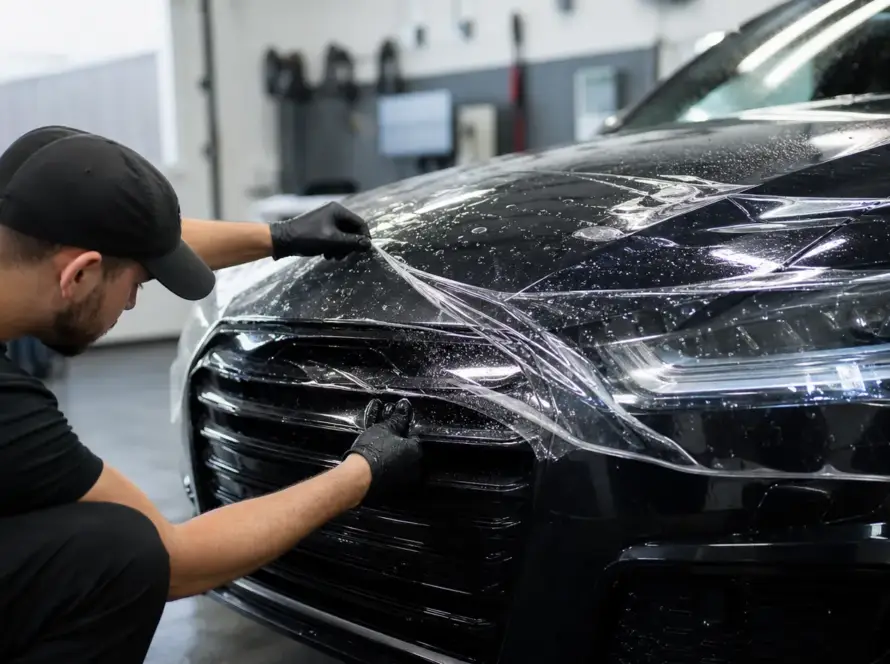
Many DIY attempts fail because they overlook the microscopic contaminants that a simple car wash leaves behind. Professional installation requires a multi-stage process to ensure the film bonds correctly and remains invisible:
- Chemical Decontamination: Removing iron fallout and tar that can create bumps under the film.
- Mechanical Decontamination: Using clay bars to pull embedded pollutants from the clear coat.
- Panel Wiping: Using an alcohol-based solution to strip any remaining oils or waxes that could interfere with adhesion.
The installer’s role is to create a clinically clean surface. Whether you are applying clear protection or a cosmetic change like a piano black car wrap, the goal is an “invisible” finish where the film disappears into the paint. Our films feature advanced air-release technology to assist in this process, but the ultimate clarity and longevity of the installation depend entirely on this critical prep work. Without it, you are simply sealing in defects rather than correcting them.
Real-World ROI: Is the Transformation Worth the Cost?
When we analyze the before and after ppf car scenarios, the visual upgrade is undeniable, but the financial argument is what truly closes the deal. For our wholesale partners and their customers, installing Paint Protection Film is a strategic move to lock in vehicle resale value. Factory paint is a finite asset; once a panel is repainted due to rock chips or scratches, the vehicle’s market value often takes a significant hit because it is no longer original.
The economics of protection are straightforward when you compare preventative measures against repair bills:
- Restoration Costs: A high-quality body shop respray to fix extensive road rash or deep scratches can cost thousands of dollars and often results in mismatched paint textures.
- Preventative Defense: Applying our self-healing TPU film is a one-time investment that stops damage before it starts, maintaining that showroom finish indefinitely.
Understanding the breakdown of car PPF cost helps clarify why preventative maintenance is far cheaper than reactive repairs. With our factory-direct pricing and up to 5-year warranties on specific products, the ROI is clear—you are preserving the pristine “after” condition permanently, avoiding the depreciation that inevitably comes with daily wear and tear.


 English
  Portuguese
  Spanish
  German
  French
  Hindi
Hindi